
Streptomyces mayonensis (Filipino)
Mula sa bulkan tungong pharmacy Bakterya mula sa Mayon, potensyal na panlaban sa malubhang impeksyon, kanser Tingnan ang aming Facebook post dito. Natuklasan ng Filipino scientists ang Streptomyces mayonensis, isang bagong uri ng bakterya mula sa Mayon na kayang labanan ang ilang mapanganib na pathogen, kabilang ang drug-resistant na impeksyon sa staph, Salmonella, drug-resistant na pulmonya, at fungal infections. Nagpakita rin ito ng potensyal na mapabagal ang paglaki ng mga cancer cells sa colorectal cancer sa tao. Ang strain ay kabilang sa isang grupo ng bakterya na taglay ng halos 80 porsyento ng mga antibiotiko sa buong mundo. Napapanahon ang pagkatuklas sa naturang species sa kasagsagan ng tinatawag ng World Health Organization na “pandaigdigang krisis sa inobasyon.” Sa ulat ng WHO noong Hunyo 2024, nagbabala ito na kailangan nang makahanap ng mga bago at epektibong gamot para sa mga malubhang sakit, pati na rin ng mga kapalit para sa mga gamot na hindi na epektibo dahil sa antimicrobial resistance. Kung hindi matutugunan, ang mga bansang may mababa hanggang katamtamang kita tulad ng Pilipinas ang pinakamaaapektuhan nito. Unang inilathala ang pananaliksik nina Oliveros noong 2021 sa Philippine Journal of Science. Noong nakaraang taon, kinumpirma sa pamamagitan ng whole-genome sequencing at biochemical analysis na ito ay isang bago at natatanging species—isang mahalagang hakbang bago ito maging kabilang sa opisyal na proseso ng pagbuo ng gamot. Ang mga sample nito ay nakarehistro na sa mga internasyonal na koleksyon sa Japan at Germany, at opisyal na nakatala sa global scientific record bilang discovery ng mga Pinoy. Ano ang mangyayari pagkatapos nito? Ngayong nabigyan na ng pagkakakilanlan ang bagong strain, maaari nang makabilang ang S. mayonensis sa opisyal na pipeline ng pagbuo ng gamot at biotechnology, at magsisilbi na rin itong kandidato para sa karagdagang pananaliksik. Nakatulong din ang natuklasan sa pag-unawa sa pagkakaiba-iba ng Streptomyces sa buong mundo. Ang kakayahan ng strain na mabuhay sa sa kabila ng nararanasang environmental stress ay patunay sa pagiging produktibo ng mga bulkan at sa posibilidad na maaari itong pagkunan ng mga bagong compound mula sa mga mikrobyo. Ang pag-aaral nina Oliveros ay patunay na mayroon tayong scientific capacity para tumuklas. Kung patuloy mag-i-invest sa pananaliksik at sa imprastraktura ng bioprospecting, malaki ang potensyal ng ating mga likas na yaman upang makapag-ambag sa pandaigdigang paghahanap ng mga bagong gamot.
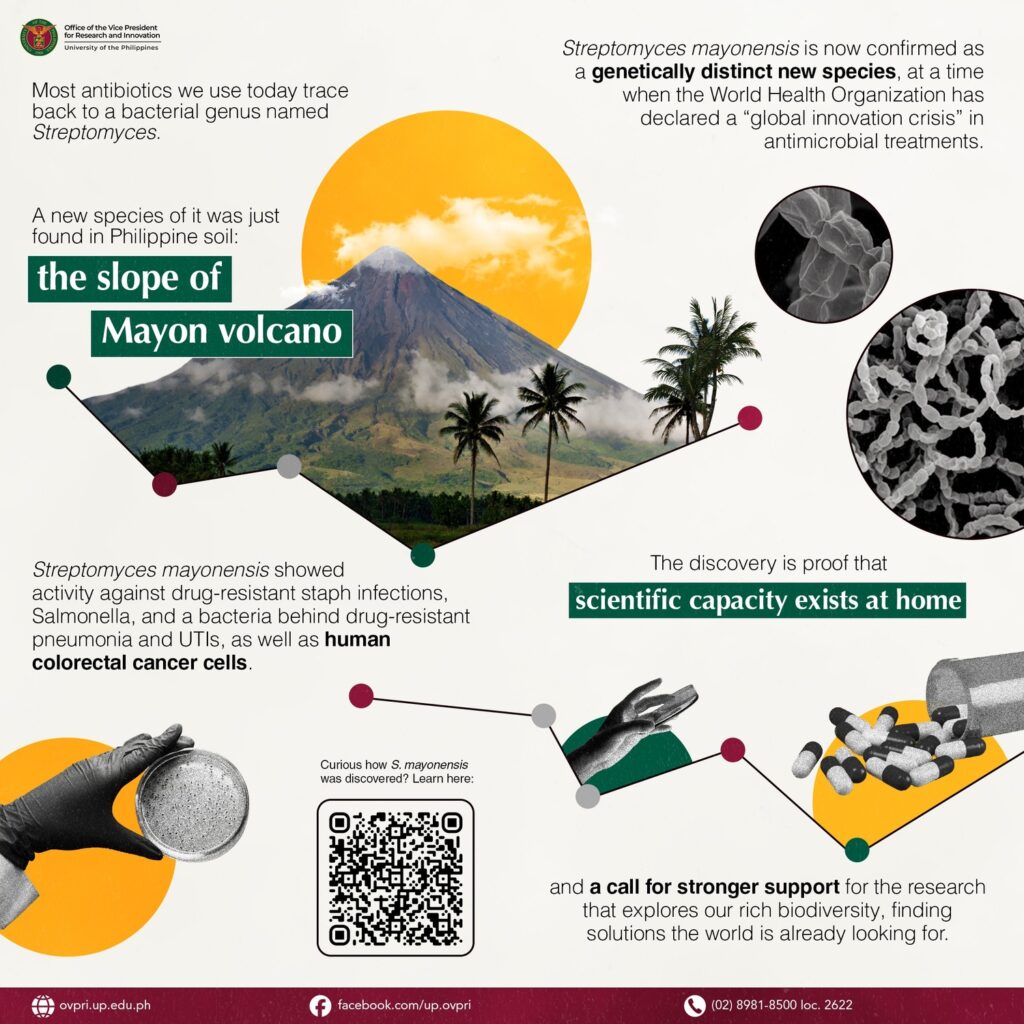
From volcano to pharmacy Bacterium from Mt. Mayon shows promise against serious infections, cancer Check our Facebook post here. A team of Filipino scientists has discovered Streptomyces mayonensis, a new species of bacteria found in the volcanic soils of Mt. Mayon. In lab testing conducted by Kristel Mae P. Oliveros (UP Los Baños), Gerald M. Aguilar (UP Los Baños), Albert Remus R. Rosana (UP Los Baños; Department of Science and Technology), Rina B. Opulencia (UP Los Baños), and Asuncion K. Raymundo (UP Los Baños; National Academy of Science and Technology), the strain showed activity against several dangerous pathogens, including drug-resistant staph infections, Salmonella, drug-resistant pneumonia, and fungal infections. It also demonstrated potential in slowing the growth of human colorectal cancer cells. The strain belongs to a genus responsible for roughly 80 percent of the world’s antibiotics. The discovery comes amid what the World Health Organization has called a “global innovation crisis.” In its June 2024 report, WHO warned that there is an urgent need to develop new, innovative cures for serious diseases and substitutes for existing ones that have become ineffective due to antimicrobial resistance. If left unaddressed, this dilemma bears most heavily on low- and middle-income countries like the Philippines. The research was first published in the Philippine Journal of Science. Last year, whole-genome sequencing and biochemical analysis confirmed it as a new and genetically distinct species—a prerequisite before any compound it produces can enter the formal drug-development pipeline. Reference cultures have since been deposited in international collections in Japan and Germany, securing the discovery within the global scientific record under a Filipino name. What’s next? By resolving the strain’s scientific identity, the study clears the way for S. mayonensis to enter the formal pharmaceutical and biotechnological development pipeline, turning a previously bioactive but unclassified microbe into a documented candidate for further drug discovery. The findings also enrich the global understanding of Streptomyces diversity, and the strain’s genetic toolkit for surviving environmental stress offers compelling evidence that volcanic ecosystems are productive, and perhaps largely untapped, areas for novel microbial compounds. Oliveros et al.’s (2025) is proof that scientific capacity exists at home. With continued investment in research and bioprospecting infrastructure, the country’s natural resources stand ready to contribute to the world’s search for new medicines. View Tagalog translation