
SEA’s Space on Space: A Humanities Perspective from Southeast Asia
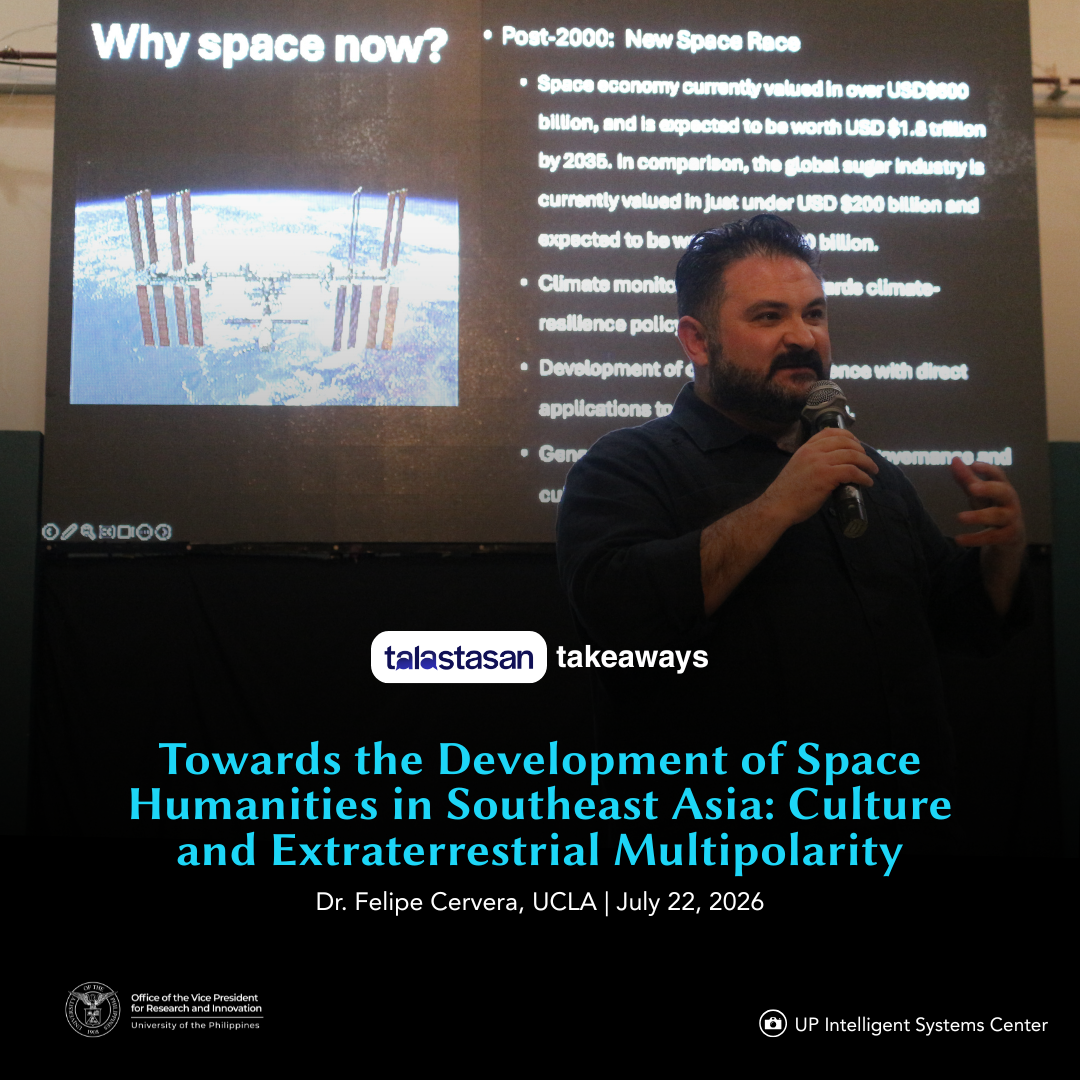
A cotton plant once grew on the moon, sprouting aboard China’s Chang’e-4 rover in 2019, and lived for three days. From a technological perspective, it was a milestone. For a humanities one, it was that and a question: of all the plants humanity could send to another world, why cotton, a crop entangled with slavery and empire?
Dr. Felipe Cervera, Director of the Center for Performance Studies and Assistant Professor at the University of California, Los Angeles, anchored his public talk on this question.
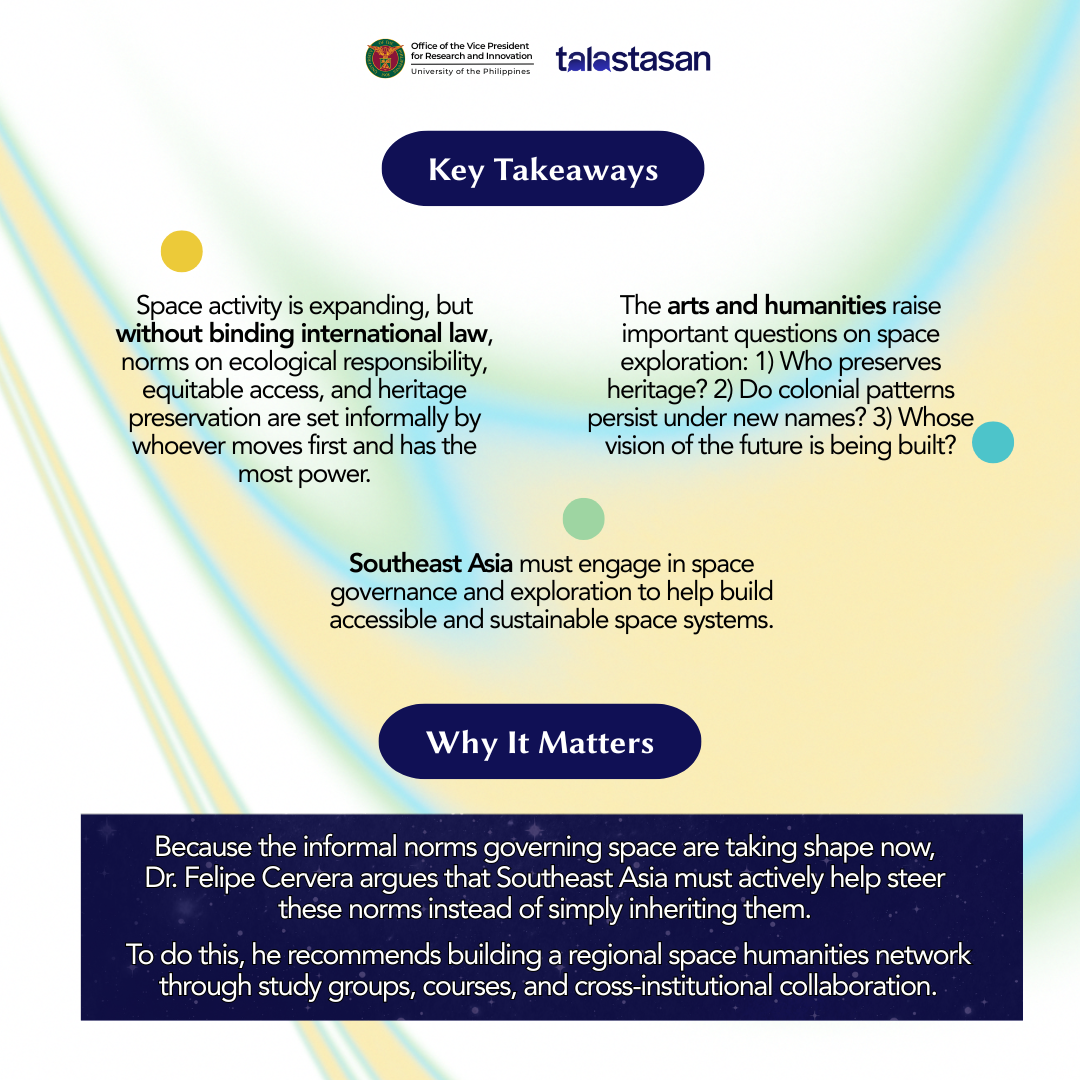
Cervera pointed out that while our technologies, planet, and societies have continually evolved, we continue to associate our encounters with the moon and Mars as colonization, following an outdated framework.
According to him, this shows that the field’s biggest gap is not technological but imaginative. The humanities and arts are urgently needed to fill it, to bring questions of meaning, culture, and imagination into a conversation science and engineering cannot cover alone.
“What if we don’t imagine the interplanetary futures as colonial? What if we don’t imagine interplanetary futures as the recreation of a terrestrial interior in another world? What if we don’t imagine colonists at all? What if we imagine the solar system as an ecology?”
He expounded this by emphasizing that life on Earth depends on the solar system, and that we are already part of one shared ecology.
This questioning matters especially in regions like Southeast Asia that have had little say in shaping what comes next for the field.
“There are questions that urgently call for a humanist to be in the room, not as a critical scholar that studies the space program [but] as someone that is part of the space program, as someone that helps science to develop in different trajectories, in different futures. So here is where non-space-faring nations actually have the greatest stake,” Cervera said.
The professor cited several existing but scattered efforts in the region, including Southeast Asian scholars, artist-led citizen science initiatives, and national space agency frameworks—some of which still borrow from Euro-American ideas and infrastructures.
He then called for a regional network for universities to share knowledge and let students and professors work across borders, allowing Southeast Asia to develop its own way of thinking about space policy.
During the event’s closing remarks, Vice President for Research and Innovation Joel Joseph Marciano, Jr. highlighted why exploring space matters specifically for the Philippines.
“The vantage point of space can connect our communities [and] enhance productivity across our country. At the same time, where we are is, as you know, the typhoon belt in the Pacific Ring of Fire, the vantage point of space helps us with valuable data, which would make better informed decisions and resource allocation for our country.”
Pointing out that responsible stewardship of space is a shared responsibility, he advised to “start bringing in the right ideas and creating awareness about responsible stewardship of space to young people” who will inherit today’s legacy.
“Make sure that we collaborate across fields. It’s not just engineers and scientists who have a say on the future of space. It’s certainly not just the businessmen, right? It’s all of us,” Marciano said.
The talk titled “Towards the development of space humanities in Southeast Asia: Culture and Extraterrestrial Multipolarity” was held last July 22, 2026 at the UP Diliman Fine Arts Gallery (Parola), drawing over 90 participants from academic, government, and civil society organizations. It was organized by UP Intelligent Systems Center, in collaboration with the UP Office of the Vice President for Research and Innovation (OVPRI) and the UP College of Fine Arts, and through the support of the UP President’s Committee on Culture and Arts (PCCA), the UPOU Creative Systems and Futures Studio (UPOU), the Philippine Space Agency (PhilSA), the UP Fine Arts Gallery (Parola), and the Space Ecologies Art and Design (SEADS) Network.
Tagged Felipe Cervera, southeast asia, space, space humanities, space law, UCLA